 In a recent post the quantities of antidepressants prescribed in England since 2008 were scrutinised.1 It was noted that there has been an unrelenting upward prescribing trend for the past 14 years (at least). While the trend has health repercussions for the patient, what does it all mean for the UK taxpayer?
Consider this: in 2017 there were 7 million UK citizens and residents 2, 17% of the population who had “received or had dispensed” antidepressants. That was in 2017; what is the number today? It would appear that members of the public are expected to believe nearly 20% of the population have experienced or are currently experiencing some level of mental illness. That’s 1 in 5 people.
Does this seem like a plausible number? When it reaches 1 in 2 – because it will if it continues at this rate – will it still be plausible? At what point will we all collectively turn around and say: wait a minute, is this demand being created?
The trajectory we are on, and the background given for it, is not credible. As it progresses it will continue to be obfuscated by much scholarly palaver and all of it, no doubt, prefaced with the usual bromides: “science tells us”, or “a recent study suggests”. A recent study no one will be able to understand except a narrow clique of insiders who are often paid (directly or indirectly, through academic grants) by the pharmaceutical industry. We are no longer beholden to a science that “investigates” the products of an industry that, to all intents and purposes, funds said science.
With all of this in mind, the crux of the matter is clear to see: antidepressants represent a marketing triumph where a large proportion of the UK population has been turned into de facto “patients suffering from mental health problems.”
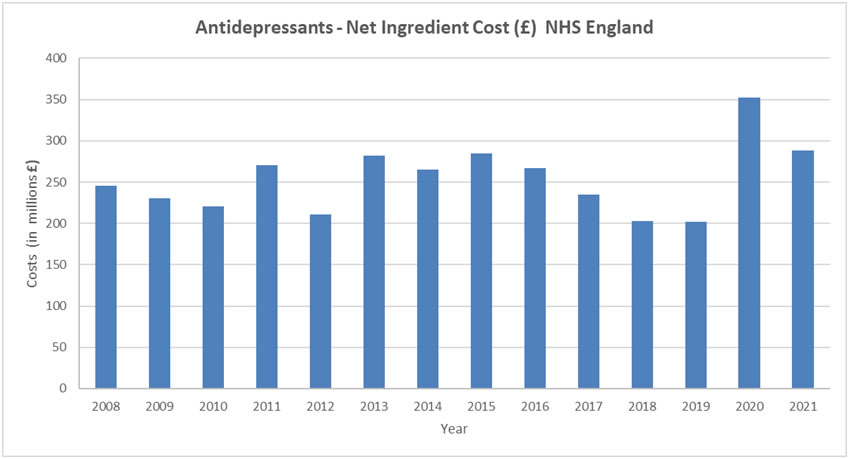
Without further ado, the numbers:
Source: 3
Since 2008, the taxpayers of England have spent £3.55 billion, or a yearly average of £254 million on antidepressant drugs. Should we be shocked? Is this a lot of money? There’s no doubt that £3.55 billion is a lot of money, but £254 million annually? Is this money being well spent? Since such speculation is purely subjective, comments should be withheld but it is worth pondering what would be most beneficial for the health of the nation.
The trend in the graph is no trend at all. It goes up and down and certainly does not progress as smoothly as the prescription quantities discussed in our last post. Cost is clearly much more volatile than demand. Overall, it must be said that costs of antidepressants are going down. This may have a number of underlying causes, not least of which expiring patents and the introduction of generic drugs. On the other hand, looking more closely, there is one year that does really stand out. It happens to be the fateful year of 2020, the year of face masks, lockdowns and mandates. Surely, the pandemic explains this sharp peak: so distressed were the citizens of England that they clutched in desperation at the straws of antidepressant drugs.
Wrong. Remember, demand has kept its steady course since 2008.
No, something else happened in the world of antidepressant drugs in 2020 and it was called Sertraline. Sertraline is generally known under the brand names Zoloft and Lustral, and is one of the best-selling SSRIs in the history of antidepressants. The costs to NHS England of this drug since 2017 are shown below. It inches up gently until 2019. Then in 2020 is shoots up like a rocket, and remains high even in 2021.

In 2020, of the £320 million spent on antidepressants in England, nearly 50% was devoted to this one drug. Costs for Sertraline went up by more than 500%, a factor of 5.
How to make sense of this?
There are a few articles from the Pharmaceutical Journal that purport to provide an explanation 4, 5. A discerning public would think a quintupling of the cost of one of the most widely used drugs in the UK would draw media attention. Not really… strange.
The pharmaceutical industry offered up its own mitigating explanation: The Pharmaceutical Journal 6 reported in April 2020 that manufacturers had indicated “industry-wide” supply challenges, exacerbated by export bans and border closures implemented as a result of the COVID-19 pandemic.
Accord Healthcare, which manufactures the SSRI, told The Pharmaceutical Journal on 23 April 2020 that its Sertraline products had been out of stock for approximately four weeks, owing to a shortage of the active pharmaceutical ingredient (API). However, it added that its 100mg tablet was due back in stock shortly, with its 50mg tablet back in stock already.
But still some insiders found this all very odd 7. Steve Bazire, honorary professor at the School of Pharmacy at the University of East Anglia, said there had been “erratic” shortages of Sertraline since the beginning of 2020, with the 100mg tablets in particularly short supply. Bazire said it appeared that the huge price increases were only being experienced in the UK.
Really, there was only a shortage in the UK. How come?
In other words, there is no robust explanation given for the five-fold increase in cost, and very little attention given to this story by the mainstream press.
In 2020, England alone spent an extra £120million on Sertraline compared to 2019. This money did not purchase more of the product. This was pure price fluctuation. Sertraline must surely be a ‘wonder drug’ if the NHS deemed it appropriate to allocate nearly half of its annual antidepressant “budget” to it.
Unfortunately for the NHS, a 2019 study by University College London doesn’t seem to agree 8:
The largest study of its kind found that most people taking Sertraline saw little or no effect on depressive symptoms, such as low mood, in the first six to 12 weeks of taking the drug… The study – the biggest of its kind – is one of the first to look at patients visiting GPs with mild to moderate depression, rather than severe cases. It compared prescribing the nation’s most popular antidepressant, Sertraline, with a dummy drug. Nearly 16m doses were doled out by GPs in the last year alone. Researchers expected the pills to have a significant effect on depressive symptoms such as poor concentration, troubled sleep and low mood, but found they had little impact.
Imagine, as a nation, you spend £149million on a drug the year after the release of a study – “the largest of its kind” – which basically demonstrates that it doesn’t work. Whichever way you look at it, that must be disappointing.
Instead of throwing the money down the antidepressant drain, I wonder how many healthy options like playing fields or bicycles could be purchased for £149million…

1 https://www.cchr.org.uk/when-it-comes-to-antidepressants-business-is-business/
2 https://www.gov.uk/government/publications/prescribed-medicines-review-report/prescribed-medicines-review-summary
3 https://opendata.nhsbsa.net/dataset/prescription-cost-analysis-pca-monthly-data
4 https://pharmaceutical-journal.com/article/news/manufacturers-report-sporadic-resupply-of-sertraline-following-covid-19-related-shortage
5 https://pharmaceutical-journal.com/article/news/manufacturers-report-sporadic-resupply-of-sertraline-following-covid-19-related-shortage
6 https://pharmaceutical-journal.com/article/news/manufacturers-report-sporadic-resupply-of-sertraline-following-covid-19-related-shortage
7 https://pharmaceutical-journal.com/article/news/cost-of-sertraline-has-increased-by-more-than-500-since-2019-figures-show
8 https://www.independent.co.uk/news/health/antidepressant-depression-sertraline-study-anxiety-mental-health-a9112781.html