The England-wide NHS prescription data for the full year 2022 has been released. So, what were the results for 2022?
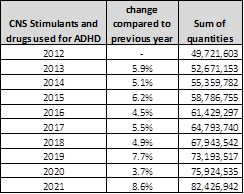
Antidepressants marked their usual steady rise at 3.3%, which is not much different than the last 15 years. Drugs used in psychoses remained relatively flat. Drugs for hypnotics and anxiolytics even showed a small dip compared to 2021. The astonishing leap however is the 15% plus increase in psychiatric drugs prescribed for so-called ‘Attention Deficit Hyperactivity Disorder’ (ADHD).

The interim figures that were released in August of 2022 revealed a hike in the use of ADHD drugs. Even in 2021, the writing was already on the wall when the year-to-year increase in the use of these drugs was already at more than 8%. Looking at the past ten years, there aren’t any of these kinds of peaks. The 8.6% increase in 2021 was already an all-time high, making the 2023 increase of 15% beyond measure.
 In September, the following question was posed: Are we witnessing an “epidemic” of ADHD cases in the UK (whatever that actually means)? What we are certainly witnessing is an epidemic of media coverage and psychiatric rhetoric. The news has been littered with articles explaining why “suddenly” so many adults are being diagnosed with ADHD, a condition typically associated with boisterous, argumentative and restless children and young adults. The diagnostic criteria represent regular childhood and adolescent behaviour, but this has been unscientifically redefined by psychiatrists. In the cold light of day, behaviour isn’t an illness. Behaviour is behaviour.
Besides the media buzz, the idea of an ADHD problem was further amplified with a debate in the UK Parliament in February 2023: Assessments for autism and attention deficit hyperactivity disorder to be debated by MPs. It was a session which could hardly qualify as a debate as there was no opposition to speak of. Instead a gallery of nodding heads collectively endorsed the proposed measures to correct the diagnosis backlog. Certainly no one expressed a slither of scepticism about the underlying premise of it all: that psychiatric drugs prescribed to children and adolescents was the only way to remedy a nebulous condition called ADHD, for which, like depression, there are no biological markers.
Here’s a theory: for whatever reason, Big Pharma started pushing ADHD drugs as early as 2021. This demand-creation had to be given a natural origin-story, so a narrative was pushed in which large swathes of the population are said to be “awaiting a formal diagnosis”, and of course, suffering all the while. The media is littered with stories of celebrities coming out with ADHD. The impression is given that there is an epidemic. The question is even debated in Parliament, giving it all an extra veneer of authority, and the usual talking heads weigh in about the seriousness of the situation. As a comparison, we’ve seen what happens when you tell people supermarkets are about to run out of toilet paper.
Meanwhile, nothing has changed. ADHD drugs in the UK are Class B drugs and in the United States, they are schedule 2 drugs. This means that in both countries, they are in a classification that is one step down from heroin. And in Europe, if your nine-year old needs to travel with an ADHD drug like Ritalin, it will fall under the Opium Act, and for this you will need a special travel certificate.
But here we are, carrying on as normal. All is apparently fine… nothing to see here. Well no, all is not fine. A 15% annual rise in prescriptions for ADHD drugs in England is an abysmal acceptance of psychiatric rhetoric that has thoroughly duped members of the public and politicians alike.
There is a very important education step that is so clearly missing. Being fully informed about the pseudoscientific basis of ADHD may be hard to swallow, but it has the potential of being more efficacious than swallowing stimulants and repurposed antidepressants. Being fully informed does not mean accepting the selective information presented by psychiatrists and pharmaceutical manufacturers. It means being diligent, without bias or agenda, and researching all of the available information.
If this was done, the prescribing figures would probably tell a different story.
Further reading: Attention Deficit Hyperactivity Disorder
Further reading: Side effects of ADHD drugs